


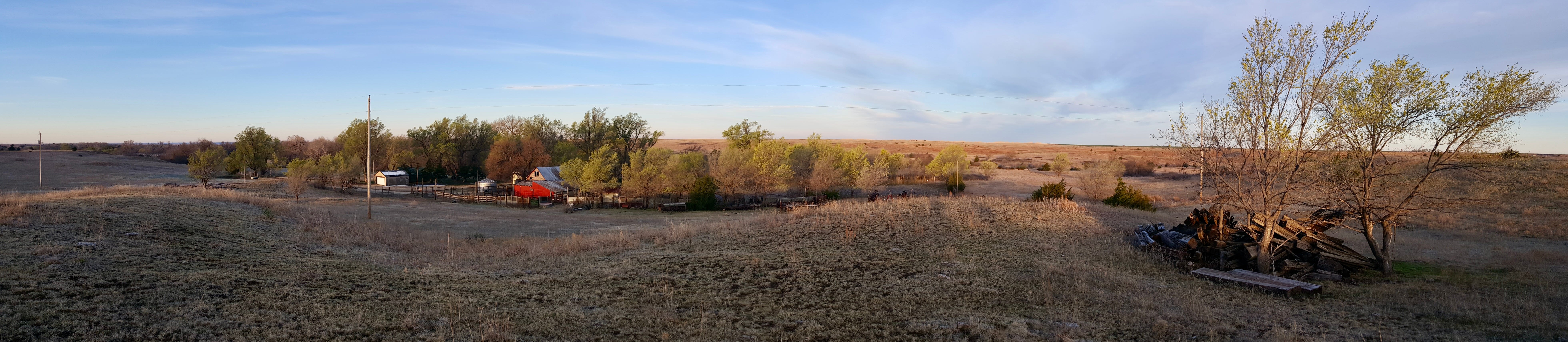
People often called the farms of my Kansas childhood “places,” as in, “just past the cemetery you’ll come to the Johnson place.” Wallace Stegner wrote that such a place “... is not a place until people have been born in it, have grown up in it, lived in it, known it, died in it—have both experienced and shaped it, as individuals, families, neighborhoods, and communities, over more than one generation.”[1]
Five generations of Chinns have owned (and eight have known) a place—a small farm in Pratt County Kansas. Many were born and raised on that land, and some died there. My soul’s architecture folds over the undulant contours of that land; the ancient hum of ancestral voices rising from the soil; massive thunderheads boiling out of the western horizon; buffalo wallows; the scents of saddles, alfalfa, and machinery.
The house is a hodgepodge of rooms hauled in by wagon, dragged in by horses, or rolled in on logs and nailed together. Two of those rooms cost my widowed great-grandmother forty dollars. That’s the only construction cost I can find. Yet through repairs, additions, and improvisations, that house has been home to people named Chinn since 1897.
The barn emerged in much the same way. When a horse killed my great-grandfather in 1900, his four young children had to grow up fast. In 1910, the thirteen-year-old twins, Eddie and Maple (my future grandpa), and their eighteen-year-old brother, Athel, built the barn. Incredibly, teenage boys built a barn that has now served its purposes for 116 years
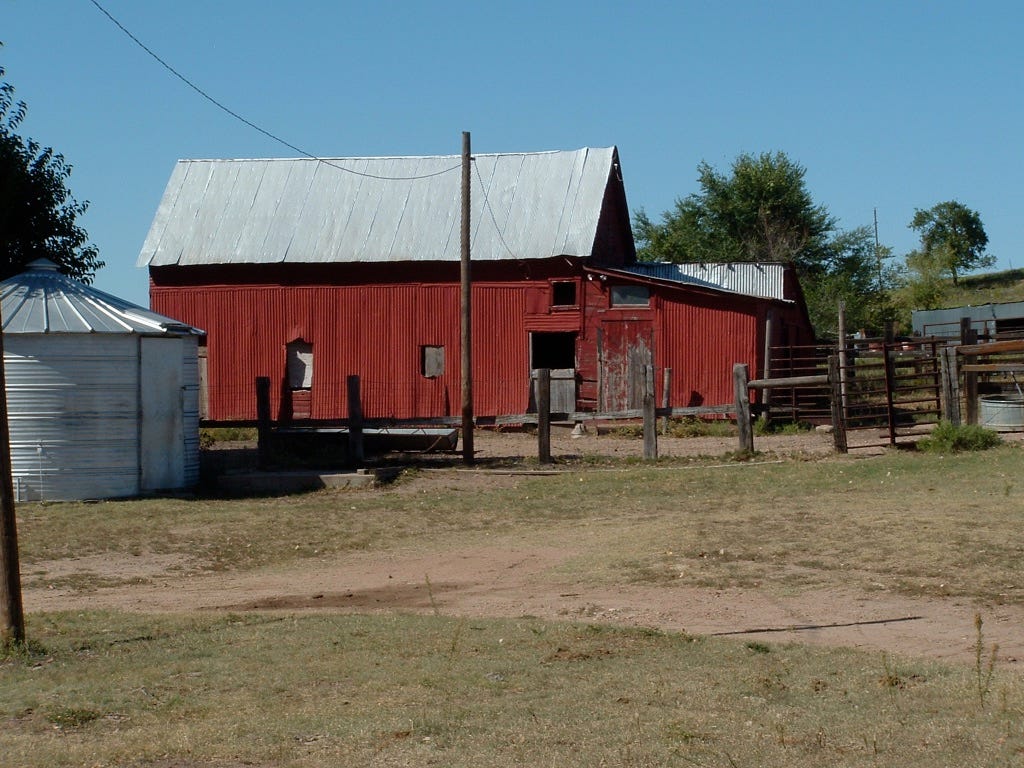
Grandpa farmed the land for sixty years (1917-1977) and Grandma gave birth to twelve children there between 1919 and 1936. The fertile land gave generously, but the Chinns upheld their end of the deal with sweat and blood.
Land hides in plain sight. Many people walk, drive, or fly over it without ever seeing it. But when humans stop, look, and listen— when they respect it and take it seriously—that partnership between Heaven and earth produces wonders. Grass, gardens, and crops, yes. But houses, highways, workplaces, cathedrals, airports, and cities also rise out of the dust of earth.
Today, we often hear people announce their need “for space,” usually as they step away from pain or the claims of maturity. Space can help, especially in stressful or painful times. But, perhaps more than space, we need a sense of place.
Space is infinite, but place is specific.
Space is romantic; place is as real as a rail spike.
We tumble through space, but we stand on a place.
Space can disorient; place can align us with true north.
A place also forms an altar where pride and illusions die. From that small farm, my grandparents helplessly watched their two-year-old daughter die and endured the Great Depression and the Dust Bowl. They were kicked in the guts by a wheat harvest that yielded barely a bushel and a half per acre. They sent three sons to World War II. They spent most of the 20th century wrestling with Heaven and earth just to pull life from the ground.
“Humus,” the Latin word for “soil,” shares the root for “humility.” We don’t ever find our place in the world without first being brought low enough to receive it.
Humility commits.
To a person, a life. To promises and a purpose.
To a place.
[1] Wallace Stegner, “Where the Bluebird Sings to the Lemonade Springs: Living and Writing in the West” New York: Random House, 1992
This is so gripping and solid. Thank you for putting into words what many, perhaps most, people are trying to find. Searching desperately to find their place.
Oh Ed, this "place in the world" piece that speaks of how "space and place" relate to one another is just masterful! This is the kind of heart-sound tapestry that should be read by everyone who longs for more space. I am grateful, my friend, for the places and spaces you and I have shared for over 50 years.